
Standard fine crumbs and extruded panko fail on commercial fish cutlet and tonkatsu lines through heavy breakage in breading applicators, a flat visual appearance and high fryer oil pickup, and 4-8mm electrode-baked large Japanese panko solves this for IQF processors and QSR chains. Large Japanese panko in 4-8mm long needle flakes (tonkatsu grade) or 6-10mm large flakes gives standing-spike texture, low breakage and lower fryer oil pickup. JIUDU Food (Nanjing, China) makes it with electrode baking at 20,000 MT per year, and holds BRC Grade A and IFS certification.
Electrode baking is a process that passes current through the wet dough so it heats from within, producing a crustless loaf with an even, airy crumb that is then cut into flakes.
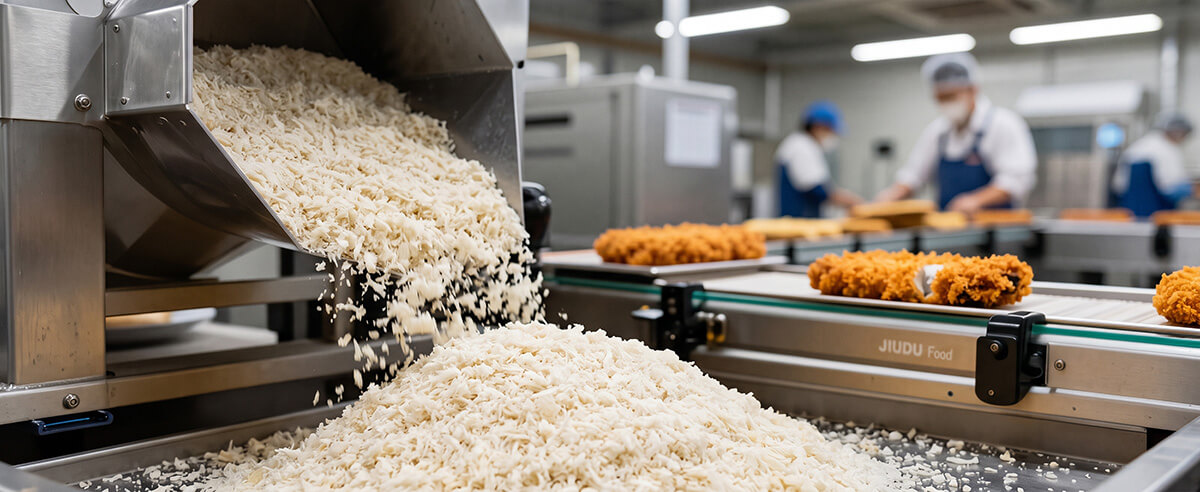
Plant managers and QA leads need a coating that survives the machine, the fryer and the freezer. We cover specs, line behavior, fryer and freezer performance, QA and sourcing. The sections ahead show which grade to pick and what to ask for on a spec sheet.
The crumb you choose decides the look of the cutlet before the oil even heats. Electrode baking heats the dough from within, so the loaf has no hard crust and an airy inner structure. That crustless, airy structure is what lets the flakes stand up and fry evenly.
Crustless flakes carry no dark crust specks, so the coating fries to an even golden color. Long needle flakes lift away from the cutlet surface and form the standing spikes buyers link with Japanese-style cutlets.

The air inside each flake does two jobs in the fryer. It gives the flake a light body, and it lets steam from the product escape instead of pushing the coating off. Crust-baked or extruded crumbs are dense, so they pack flat against the batter and look dull.
One exception applies. A thick-coated, deep-fried product may want a finer blend instead of all long flakes, because small particles fill gaps that long flakes leave.
Judge a crumb by crushing a handful and checking that it springs back without leaving powder.
Choose 4-8mm needle flakes for fish cutlets and tonkatsu, and 6-10mm flakes when you want a bolder, craggier surface. Both grades are crustless and airy, so they share the same light fry. Flake size is the main spec that changes the look.
What is like panko? A coarse, airy dry crumb comes closest, while fine bread crumbs and cracker meal are dense and sandy and fry flat.
| Product | Flake size | Texture on frying | Best product fit |
|---|---|---|---|
| Tonkatsu grade | 4-8mm | Standing spikes, light crunch | Fish cutlets, tonkatsu |
| Large flake grade | 6-10mm | Craggy, bold surface | Thick cutlets, premium lines |
| Standard fine panko | Under 4mm | Smooth, tighter coat | Nuggets, small pieces |
| Fine dry crumb | Powder to sand | Dense, flat, sandy | Binders, thin coatings |
These long needle flakes suit a Japanese fish cutlet in panko breadcrumbs and pork tonkatsu. They stick well to standard cutlet thickness and give the spiky look with little overhang.
The large flake grade gives a rougher, more dramatic crust. One mistake is ordering the largest flake for thin cutlets, where flakes overhang and fall off.
Run both grades on a short trial before locking a spec.
Breakage shows up as fines in the recirculation tray long before it shows up as customer complaints. Fines are the small, powdery particles left when flakes snap. Fines in recirculating crumb cause bald spots and heavy pickup, so an industrial breading line needs to control them.
Flatbed applicators bed and top the product with a crumb curtain. Drum applicators tumble the product and crush fragile flakes more. Batter viscosity and pickup control decide how many flakes stick.
We suggest five checks:
Drum lines need softer handling than flatbeds, so a larger flake may break more there.
Track fines percentage in the tray at each shift change to catch drift early.
Our large Japanese panko absorbs 15-20% less oil in the fryer than standard crumb. The air-filled flakes hold less oil, and that is a real gain for the oil absorption rate of a coated cutlet. IQF cutlets are usually par-fried and frozen, then finished by fryer or oven at the processor.
Airy flakes have open space that lets steam out fast. Less steam trapped means less oil pulled in as the product cools. Dense crumbs close up and soak oil into the coating.
The lighter coat also keeps a Japanese cutlet fried in panko breadcrumbs crisp longer on the line, with a cleaner mouthfeel.
Adhesion depends on batter solids and pickup. A wet batter that is too thin lets crumbs shed in the freezer tunnel, which leaves bare patches after thawing.
For an IQF frozen seafood coating, set batter viscosity so the batter grips the flakes before frying. To keep crunch after reheating, finish in a hot fryer or a dry-heat oven, not a steamy one.
Test a cutlet after a full freeze-thaw cycle, not just fresh from the fryer.
A COA that lists only moisture tells a QA team very little. JIUDU Food holds BRC Grade A and IFS certification, and a BRC certified panko factory should back each lot with a full certificate of analysis. A complete COA covers moisture, mesh and microbiology. Electrode baking also gives a consistent crumb from lot to lot.
We advise checking these items before approval:
One mistake is approving on a sample but not matching it to the batch COA. A good sample proves little if the shipped lot differs.
Request lot COAs with every shipment and file them against the approved spec.
Most processors order in 25kg bags, with 10kg bags for trials and smaller lines. Wholesale Japanese panko ships in 10kg and 25kg bags, and OEM and private label are available. JIUDU capacity is 20,000 MT per year.
| Format | Best for | What to specify |
|---|---|---|
| 10kg bag | Trials, small lines | Flake grade, bag count |
| 25kg bag | Full production | Grade, pallet size, lot COA |
| OEM private label | Branded coating programs | Blend, label, packaging |
Price depends on grade, volume and shipping. For an OEM food coating supplier quote, send those three details by email.
Specify flake grade, packaging and labeling in one purchase spec.
Change only one variable per trial run. A clean trial shows whether the crumb or something else moved the result. Changing batter and crumb at once makes the data useless.
Follow five steps on your industrial breading line:
Run each grade long enough for the recirculating crumb to reach a steady state. A ten-minute run hides fines buildup that a full shift shows.
Record results in a one-page sheet for QA sign-off.
Email sutton@jiudufood.com with your product, target volume and preferred flake grade. Samples are available for line trials, so you can test before you commit to a purchase spec.
Include the details a quote needs:
Our team can match a wholesale Japanese panko sample to your applicator type and batter. As an OEM food coating supplier, we can also adjust blends for thick-coated products that need finer particles.
Ask for a sample matched to your line.
Large Japanese panko earns its place on a line through structure. The crustless, airy flake resists breakage when handled well, fries golden and holds less oil. Match the grade to cutlet thickness, then confirm the choice with a one-variable line trial.
Send your spec to sutton@jiudufood.com to request a sample.


Hello, I am the online customer service


