
Panko is a Japanese-style bread product made into light, airy flakes rather than fine crumbs. It gives home cooks a crisp coating for tonkatsu, tempura, fried chicken, casseroles, and other foods, while helping brands offer convenient, pantry-ready recipes.
For private-label brands, distributors, retailers, and importers, reliable packaging protects product quality from filling through consumer use. The right pouch keeps bread crumbs dry, limits crushing, and helps preserve the intended texture of panko bread crumbs.
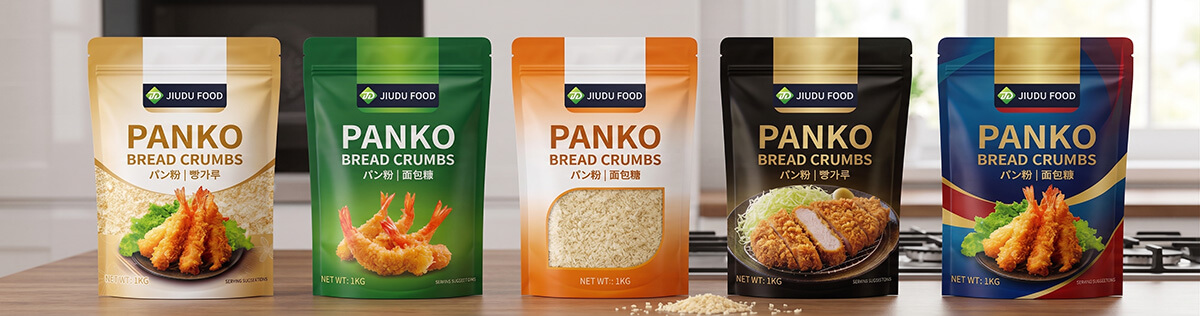
Because flakes are more delicate than conventional crumbs, humidity and compression can reduce performance and freshness. This guide explains how Panko Breadcrumbs Packaging supports shelf stability, clear product communication, and practical use across retail channels.
Unlike conventional Western bread crumbs, which are usually processed into fine, dense granules, authentic Japanese-style panko is made from bread baked with a specialized electrical heating process and cut into light, elongated flakes. These airy pieces create the characteristic crunch of panko bread crumbs and can produce a lighter coating that may absorb less oil than finer crumbs.
This structure creates two packaging risks that can affect the final texture of coated foods:
For example, intact flakes can cover a fillet more evenly and create a more noticeable crunch, while crushed crumbs may leave thin patches and a denser coating. Packaging should therefore combine a suitable moisture barrier with enough structural support to protect the intended particle size and cooking performance.
For export markets in North America, Europe, and Latin America, packaging performance helps determine how well panko retains its crispness during storage and distribution. The package must protect bread crumbs from moisture while supporting the required shelf life for the product and route.
Moisture vapor transmission rate (MVTR) measures how readily water vapor passes through a film, while oxygen transmission rate (OTR) measures how readily oxygen passes through it. Single-layer polyethylene (PE) or oriented polypropylene (OPP) may not provide enough protection for every moisture-sensitive panko bread crumbs product, especially when long storage, humid climates, or extended ocean freight is expected.
Packaging dry coating ingredients in multi-layer stand up food pouches engineered with laminates such as PET/VMPET/PE or PET/AL/PE can combine printability, puncture resistance, and improved barrier performance. Metallized film can provide strong protection with a lighter construction, while an aluminum layer may offer a more complete barrier; the appropriate choice depends on product targets, cost, recyclability goals, and test results. Neither structure should be treated as universally superior.
Select packaging through barrier testing, seal testing, and distribution simulations that reflect the intended storage conditions. A reliable zipper and well-designed bottom gusset are also important: seal integrity limits moisture ingress after filling, correct zipper placement supports repeated opening, and the gusset helps the pouch remain upright without placing unnecessary pressure on the crumbs.
At the shelf, a pouch must communicate product quality, use, and value quickly. For a private-label panko brand, packaging should help shoppers recognize the product, understand its texture, and see how the bread crumbs fit into everyday recipes.
For importers and FMCG brands, custom stand up pouch bags can provide visibility, usability, and brand differentiation:
When developing retail panko bread crumbs packaging, evaluate the following specifications with the product’s bulk density, flake size, target market, and distribution route in mind. Confirm pack dimensions after filling trials, as coarse and fine crumbs can occupy different volumes.
| Feature | Standard Recommendation | Commercial Purpose |
| Typical Retail Sizes | 200g, 350g, 500g, 1kg | Supports single households through family-size use; confirm the final size against demand, product density, and local labeling requirements. |
| Pouch Style | Doyen or K-Seal Stand-Up Pouch | Provides a balanced footprint and stable shelf presentation when the dimensions and fill weight are properly matched. |
| Closure Mechanism | Resealable Press-to-Close Zipper | Helps limit moisture ingress after opening and supports repeated use; verify zipper performance through cycle testing. |
| Material Structure | PET / PE or Matte PET / VMPET / PE | Balances print quality, puncture resistance, moisture barrier performance, appearance, and cost; select the structure through barrier and seal testing. |
| Secondary Packaging | Corrugated master cartons (12/24 units) | Helps protect filled pouches from compression during pallet transport and container handling; confirm the configuration through drop and compression testing. |
A reliable private-label program connects recipe consistency with packaging performance. JIUDU Food offers a factory-direct option for panko, bread products, and other food coatings, with specifications you can review before commercial approval.
At JIUDU Food, buyers can review bread crumbs and panko bread crumbs for different applications, including fried foods, coatings, and topping formats.
If you are preparing a panko bread crumbs launch, request samples, product specifications, barrier recommendations, compliance documents, and a packaging quotation through the JIUDU export team. Confirm the target market, pack size, film structure, closure, artwork, regulatory requirements, and order volume before production.


Hello, I am the online customer service


