
Could a single choice in coating decide whether your product wins on the shelf and at the table?
Manufacturers aiming to perfect fried-baked lines must understand how different crumbs affect texture, shelf life, and consumer appeal.
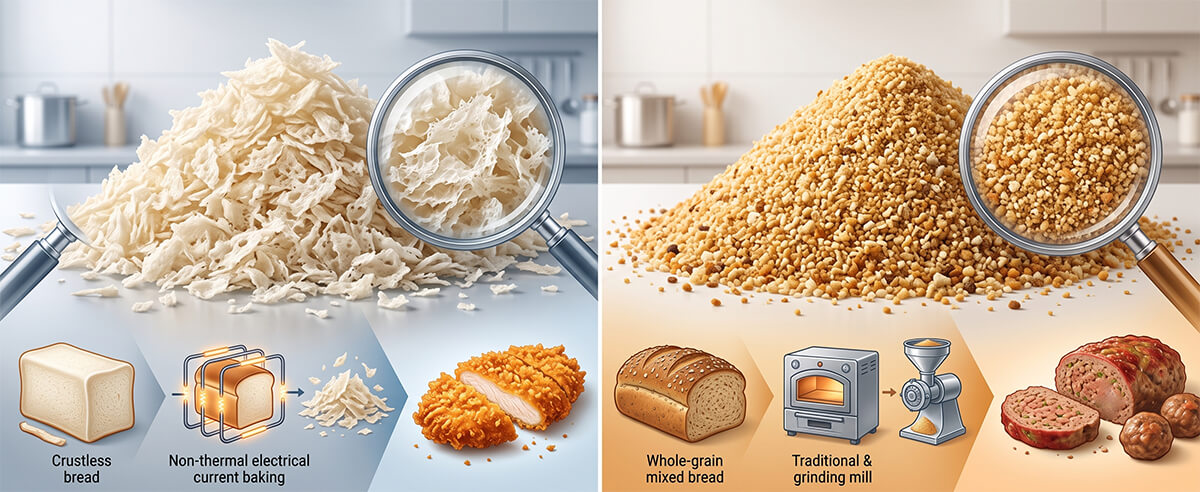
The Japanese term for this lighter, flakier bread product has become a global pantry staple for food developers. Its unique structure gives a crisp finish that many standard options cannot match.
Comparing regular panko varieties with traditional bread crumbs helps teams choose the right crumb for high-volume production. That decision affects cooking performance, product integrity, and the eating experience.
In this article, we break down coating behavior, material handling, and sensory outcomes so you can pick the best solution for your foods.
What you coat a product with controls texture, moisture, and the eating experience. Breadcrumbs are a broad category that encompasses many types of ground bread used across food lines.
Panko is a distinct, engineered option with a flaky, open structure. This structure creates a lighter, airier crust and a noticeably different mouthfeel compared with denser crumb forms.
Standard bread crumbs often deliver uniform density that helps bind ingredients and retain moisture in recipes. Manufacturers favor these for predictable performance and ease of formulation.
Key practical points for product teams:
Understanding these fundamentals helps R&D choose the right crumb for targeted texture and production goals.
A non-thermal baking method yields large, open flakes that change frying performance. Manufacturers select specific inputs and steps to ensure coatings perform consistently on high-volume lines.
Crustless white bread is the base for the lightest flakes. Removing the crust keeps the color and flavor neutral.
Tan varieties arise when crust forms or when different loaf types are processed. That change alters texture and oil uptake.
Traditional heat browns the crust. The electrical current method does not. This preserves a pale crumb and creates an airy internal structure.
Historical notes say Japanese soldiers used tank batteries to bake loaves, which inspired the modern electrical approach. The result: flakes that are larger and less dense than ground bread.
| Feature | Crustless White Product | Standard Ground Bread |
| Primary input | Crustless white bread | Mixed loaf types with crust |
| Texture | Large, airy flakes | Fine, dense particles |
| Oil absorption | Lower oil uptake | Higher oil retention |
Coating choice often dictates how much oil a product takes on and how crisp the final bite feels.
Flake-based crumbs absorb less oil and produce a lighter, airier crust. This makes them ideal for fried items such as chicken katsu and other fried foods where a crispy coating is a selling point.
Ground bread particles tend to compact. They hold more grease and can make a product heavier. That extra oil raises calories and alters mouthfeel.
| Attribute | Flake-style | Ground-style |
| Oil absorption | Low | High |
| Resulting texture | Light, crunchy crust | Denser, chewier surface |
| Best uses | Fried baked items, chicken, crispy coatings | Meatloaf, casseroles, and binder meatballs |
Practical takeaway: select a flake-based bread for a crisp exterior, and choose a ground bread when binding and moisture retention are priorities.
Nutrition labels reveal how coating choices affect calories, sodium, and macronutrient content in finished products.
Key figures matter: Kikkoman Sales USA reports that 1/2 cup of panko contains 110 calories, 24 g carbs, 2 g sugar, and 4 g protein. Nutritionix lists 168 calories, 30 g carbs, 3 g sugar, 6 g protein, 2 g fat, and 2 g fiber per 1/2 cup of bread crumbs.
Salt differences are notable. The flake-style option has about 50 mg of sodium per serving, compared with roughly 220 mg in plain breadcrumbs. That gap helps meet low-sodium targets without reformulating core recipes.
| Metric (½ cup) | Flake-style | Ground bread |
| Calories | 110 | 168 |
| Fat | 0 g | 2 g |
| Sodium | 50 mg | 220 mg |
| Protein | 4 g | 6 g |
Practical takeaway: choose the lower-calorie crust when you need a lighter product; choose ground bread when structure and added fiber matter.
A neutral crumb can act like a blank canvas, taking on spices and herbs without competing with the main protein.
Panko made from crustless white bread offers a mild base that highlights the coated food. This neutrality keeps chicken and other proteins as the star while letting seasonings shine.
Manufacturers often use seasoned bread mixes—such as Italian herbs, cheese, or garlic—to add depth. Use these sparingly; heavy seasoning can mask moisture balance and alter texture.
Options like pork panko, made from ground pork rinds, provide a savory crunch and higher fat content. This type suits products targeting bold, snack-forward flavor.
"Use a neutral crumb to preserve the core flavor; add layers with targeted seasoning blends when you want a signature taste."
| Feature | Neutral Flake | Seasoned Mix | Pork-based |
| Primary use | Fried chicken, coatings | Meatloaf, casseroles | Snack coatings, bold dishes |
| Flavor impact | Low | High | High, savory |
| Effect on moisture | Minimal | Variable | Increases oil |
When recipe teams swap one crumb for another, the finished product's texture and oil uptake change fast.
Direct substitution is usually simple: manufacturers can often replace bread crumbs with a flake-style option at a one-to-one ratio to improve crispness without altering batch weights.
For fried baked lines like chicken katsu, this swap yields a lighter, less greasy result. That reduces oil absorption and enhances shelf appeal.
Use the flake in applications where a crispy coating must stay distinct, such as cheese-topped casseroles. By contrast, ground bread works better when moisture retention and binding are priorities, as in meatloaf.
Bottom line: choose substitution based on desired crunch, moisture, and visual outcome—then validate with production-level tests.
The coating you pick controls mouthfeel and can be a key differentiator in competitive categories.
Panko made from crustless white bread delivers large, airy flakes that create a distinct crunch. That physical structure is the core difference in the finished product's feel.
Choose bread crumbs when binding and moisture retention are priorities. Note the trade-offs: lighter crusts lower oil uptake while denser crumbs add body and flavor.
Test coatings at line speed to measure oil absorption and final texture. Small trials reveal the real-world impact on shelf appeal and nutrition.
Bottom line: for a light, crispy finish, select a flake-style option; for structure and moisture, choose traditional bread choices. Consider targeted trials with panko regular to verify results.


Hello, I am the online customer service


